

French universities remained hardly accessible to women. The faculty of Bordeaux, created in 1441, then (re)created in 1870 after its abolition in 1793, illustrated this lack of diversity. The study of the University of Bordeaux in the Great War is a good example to portray the entrance of women – these pioneers – in French higher education, and their commitments as active members of student associations. In France, Emma Chenu and Julie-Victoire Daubié were the first two female students. Respectively enrolled for the former in science and mathematics in 1867, for the latter in Humanities in 1871 (first Frenchwoman to be granted a bachelor’s degree at the faculty of Lyon in 1861). In law studies, it was not until 1884 that two women (one Russianpour lire la suite…
Tag: France
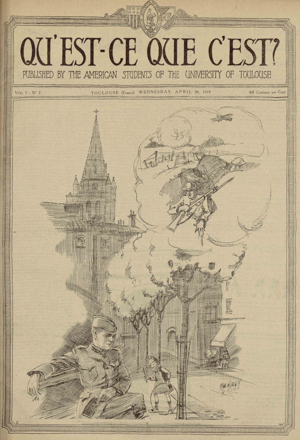
American students at the Toulouse Faculty of Law
Shoulder Arms, Charlie Chaplin’s film, released in the United States on October 20, 1918, features Charlot trying to train in an army camp. When evening comes, he falls asleep and wakes up in a trench in France sharing the expectation and the idleness of his companions in misfortune. He volunteers for an espionage mission. Returning a hero, having saved a young French woman and captured Kaiser Wilhelm II, Marshal Hindenburg and the Kronprinz. Chaplin was no stranger to the poilus when his film was released in France on April 20, 1919 under the name Charlot Soldat. In 1915 at the Bois de la Vache in Somme, Swiss Frédéric Louis Sauser, alias Blaise Cendrars, while he was serving in the French army as a foreign volunteer,pour lire la suite…
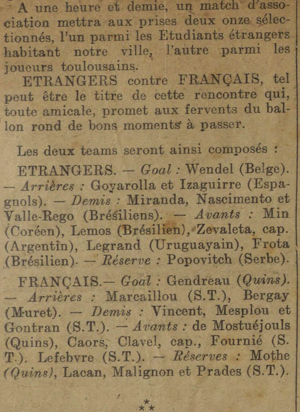
Welcoming foreign students at the Toulouse Faculty of Law
To talk about this theme shows how the academic environment has changed in very few generations of students. How many generations was it by the way? For the Toulouse Faculty of Law, the inflection point may be associated with a change in status, in power seat, in symbol. In 1971, the Toulouse Faculty of Law and Economics became the University of Social Sciences; the last dean, Professor Marty, was the first president of the new entity; the place of power shifted from the “old college” of regulars to the spaces perceived as sanitized by the “new university”, quickly decorated with the name inherited from the old military power that had inhabited it since the Revolution: the Arsenal. In the new academy, foreign students were nopour lire la suite…
Foreign law students in France in the Great War
Foreigners’ law studies in France The vast majority (nearly 80% in 1902) of foreign students enrolled in 1913 at the Paris Faculty of Law were taking bachelor’s and/or doctorate level courses, after having presented a secondary school diploma recognized as equivalent to the French baccalauréat; a small number (18%) were simple registrants who sought only a certificate of attendance that could be used in their country, often jurists in search of professional development. Some 60 Egyptians who had begun their studies at the French School of Law in Cairo and who came to take their examinations in Paris are added to the list because of their numerical importance. In the last years of the 19th century, in hopes of preventing foreign graduates from setting uppour lire la suite…
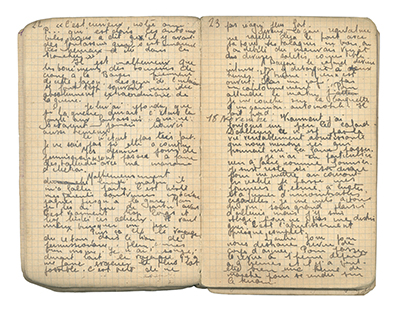
Students of the Lyon Faculty of Law in the First World War
On the eve of the first world conflict, with its 15 tenured professors and 585 students, the young Lyon State faculty held an intermediate rank in the cohort of French faculties of law. Its creation, it is true, was still recent, since it had taken the law of 1875 on the freedom of higher education and the prospect of seeing the old capital of the Gauls become the seat of a Catholic law school, animated by monarchist and very conservative aldermen of Lyon, for the creation of the state faculty to finally become an apparent necessity in the eyes of republican political leaders. Hastily improvised in the fall of 1875, the young institution of higher education quickly found its audience. Its recruitment pool was quitepour lire la suite…
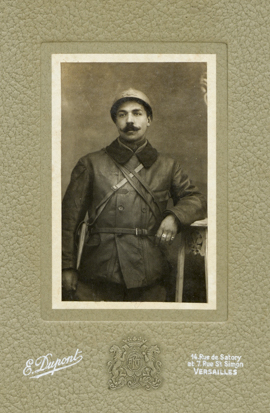
Portraits of Toulouse students in the war
In Toulouse, the academic year of the first year of war began on November 9, 1914. It unfolded “normally”, Dean Maurice Hauriou reported to his assembled colleagues. And yet the numbers speak for themselves. After 1,032 enrollments in 1913, only 295 in 1914. By 1916, only 175 enrollments would be registered and, although the increase somewhat resumed later, it was not until 1930 that the threshold of a thousand new students would again be crossed. The Toulouse Faculty of Law of was hit hard by the outbreak of hostilities. While many had already joined their regiment or would gradually leave, those in the rear were expected to mobilize in their own way as well. For the deferred and exempted conscripts, though sometimes very temporarily, aspour lire la suite…
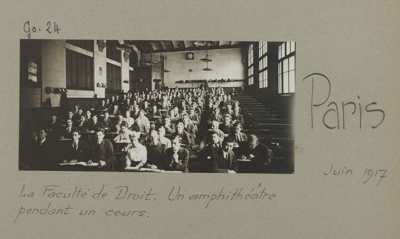
French law students in the Great War
In the 19th century, law students at the Faculty of Paris belonged to the middle or upper classes and, unsurprisingly, a fifth had a father practicing a legal profession (judge, lawyer, notary, etc.); 40% were sons of landowners or annuitants, 13% sons of traders, merchants or manufacturers, 11% sons of civil servants, 4% sons of doctors or pharmacists, and 3.5% sons of teachers. More than their fellow students enrolled in medicine, literature or science, these students are from Paris and the Seine department (22%), and not from a provincial city, which is an indication of material ease. Finally, while at the end of the century, 80% of medical students lived on the left bank and 19.4% on the right bank of the Seine, one thirdpour lire la suite…
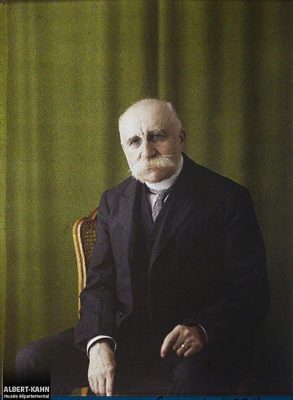
Raymond Thamin (1857-1933): Memoirs of the Rector of the Academy of Bordeaux in the Great War
Examining the past in search of information on the Bordeaux Faculty of law during the Great War, historians can only be compelled by the discovery of an unknown figure who was nevertheless an important public figure in the history of the Third Republic. Indeed, Raymond Thamin, rector of the Academy of Bordeaux during the Great War, was a scholar with an exceptionally brilliant career. Alumnus of the École Normale Supérieure (1877), professor of philosophy (1880), doctor of letters with a thesis on Saint Ambrose and Christian morality in the 4th century (1896), lecturer at the Faculty of Humanities (1884) and professor at the Lycée Condorcet in Lyon (1894), author in particular of a book on the philosophy of pedagogy titled “L’éducation et le positivisme”, encensedpour lire la suite…
The University Library of Dijon on the war front (14-18): continuity and American influence
Forword The University of Burgundy was founded belatedly in 1722 as a single faculty of Law. Closed during the Revolution, it was one of only twelve Law Schools reinstated by decree in 1804. Inaugurated in 1806, it was joined in 1808-1809 by a faculty of Arts, a faculty of Sciences, and a “école spéciale de médecine et de pharmacie” [special school of Medicine and Pharmacy]. Having originally been limited to a faculty of law, this aspect thus remained dominant for a long time, particularly in the collections of the university library. During the First World War, Dijon was considered a “rear city”. Thanks to its geographical location, Dijon became a base for French and American military regiments, and a transit point for refugees and troopspour lire la suite…
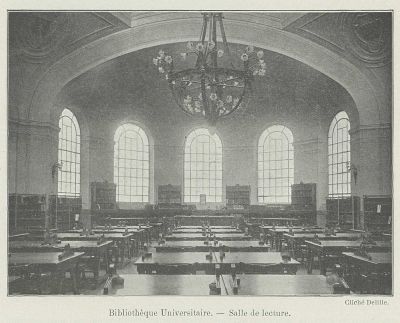
The University Library of Lille in the Great War
History and functioning Until 1887, the Faculties of Law and Humanities and their library were located in Douai. On that date, the two faculties joined the faculties of science and medicine in Lille, with an organizational chart already merging all libraries. The four faculties were then reunited at the University of Lille in 1896. In 1914, the university library was housed in a recent building, inaugurated in 1907. This building was specially designed to serve as a library: it met the professional standards of the time. In 1903-1904, director of the library Paul Vanrycke took a study trip to Germany (then including Strasbourg), Belgium and the Netherlands to prepare his project. The building covered 1,570 m², or 16,900 sqft. The reading room was lit bypour lire la suite…