

The Catholic law faculty had just finished its degree exams when war broke out, but despite the events, it reopened its doors in November. However, due to the conscription of almost all of their students, the theology faculty and university seminary were unable to resume classes. Classes resumed on November 4 for first- to third-year law students, but without the traditional formal opening ceremony, which was suspended for the duration of the war. In 1914, a mass celebrated by the cardinal chancellor on November 19 and attended by teachers and students replaced the ceremony. Not many professors were called up during the war (only twelve from all the Catholic faculties in Lyon). To our knowledge, only Emmanuel Gounot, a young lecturer (aged 29 at thepour lire la suite…
Category: Institutions in the face of History
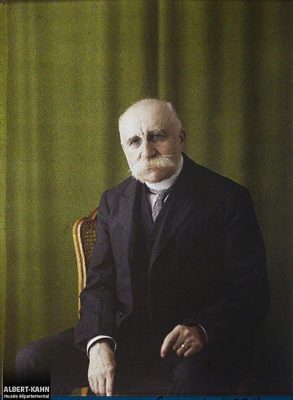
Raymond Thamin (1857-1933): Memoirs of the Rector of the Academy of Bordeaux in the Great War
Examining the past in search of information on the Bordeaux Faculty of law during the Great War, historians can only be compelled by the discovery of an unknown figure who was nevertheless an important public figure in the history of the Third Republic. Indeed, Raymond Thamin, rector of the Academy of Bordeaux during the Great War, was a scholar with an exceptionally brilliant career. Alumnus of the École Normale Supérieure (1877), professor of philosophy (1880), doctor of letters with a thesis on Saint Ambrose and Christian morality in the 4th century (1896), lecturer at the Faculty of Humanities (1884) and professor at the Lycée Condorcet in Lyon (1894), author in particular of a book on the philosophy of pedagogy titled “L’éducation et le positivisme”, encensedpour lire la suite…
The University Library of Dijon on the war front (14-18): continuity and American influence
Forword The University of Burgundy was founded belatedly in 1722 as a single faculty of Law. Closed during the Revolution, it was one of only twelve Law Schools reinstated by decree in 1804. Inaugurated in 1806, it was joined in 1808-1809 by a faculty of Arts, a faculty of Sciences, and a “école spéciale de médecine et de pharmacie” [special school of Medicine and Pharmacy]. Having originally been limited to a faculty of law, this aspect thus remained dominant for a long time, particularly in the collections of the university library. During the First World War, Dijon was considered a “rear city”. Thanks to its geographical location, Dijon became a base for French and American military regiments, and a transit point for refugees and troopspour lire la suite…
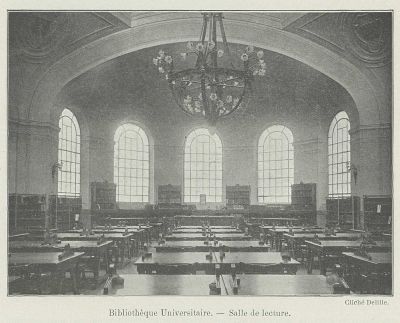
The University Library of Lille in the Great War
History and functioning Until 1887, the Faculties of Law and Humanities and their library were located in Douai. On that date, the two faculties joined the faculties of science and medicine in Lille, with an organizational chart already merging all libraries. The four faculties were then reunited at the University of Lille in 1896. In 1914, the university library was housed in a recent building, inaugurated in 1907. This building was specially designed to serve as a library: it met the professional standards of the time. In 1903-1904, director of the library Paul Vanrycke took a study trip to Germany (then including Strasbourg), Belgium and the Netherlands to prepare his project. The building covered 1,570 m², or 16,900 sqft. The reading room was lit bypour lire la suite…
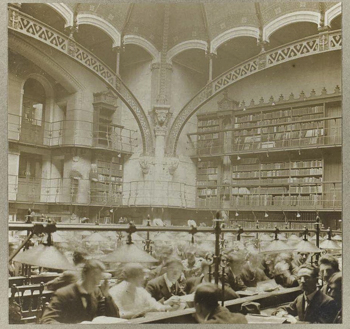
The library of the Paris Faculty of Law in the Great War
At the beginning of August 1914, when war broke out, the library of the Faculty of Law of Paris was a well-established and ever-expanding institution (by comparison, see the article on the library of Toulouse). Its development had begun thirty-eight years earlier, starting in 1876, with the appointment of its first professional librarian, Paul Viollet. Reflecting a desire to move the structure out of its embryonic state, this appointment was accompanied by architectural construction, an increase in budget and an increase in the number of staff members. Thus, between 1876 and 1914, under the leadership and direction of Viollet, the library grew from 20 to nearly 300 seats, from 15,000 to 112,000 books, from a few dozen to about 600 periodical subscriptions, from two topour lire la suite…
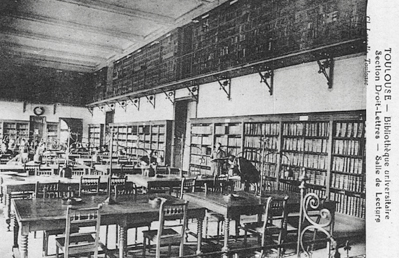
The humanities section of the University Library of Toulouse in the Great War
In an effort to raise the level of higher education in the country, and in view of the importance of libraries in achieving this goal, the Third Republic undertook, through an abundance of regulatory production, to organize university libraries. In Toulouse, these efforts resulted in the creation, in 1879, of a unified university library. But it was not until 1891 that the definitive organization was established with, to serve the four faculties, two geographically distinct sections: science and medicine in the alleys of Saint-Michel, and humanities, including law, on the premises of the law school, currently called “former faculties”. The humanities section soon became too cramped and moved in July 1910 to 56, rue du Taur, on the premises of the former great seminary ofpour lire la suite…
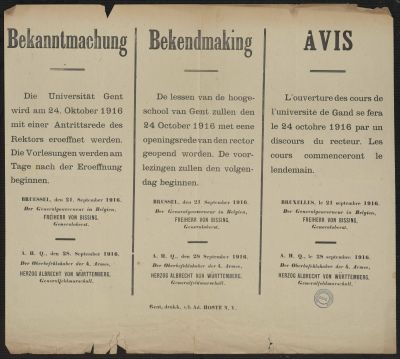
The “Von Bissing University” in academically locked Belgium
The establishment of the Vlaamsche Hoogeschool, better known as the “Von Bissing University”, marks a high point in the period of occupation and the relations between the occupying authorities, Flemish activists and “patriots” during this period. While, in the context of the occupation, universities closed, an academic institution was created in Flanders — in Ghent — in 1916, with the support of German authorities. Presenting this moment and this particular institution requires to situate it in the context of the Flemish claims that had been developing in the previous decades. Since independence, Belgium had made French its only official language and had neglected the Flemish language and culture. All education was given in French. The Flemish movement, which had been developing in Belgium since thepour lire la suite…

A space to maintain law education in Brussels: the New University
The German invasion in August 1914 was soon followed by the occupation of most of the country. The context of war and occupation was an obstacle to the resumption of classes: many of the professors and students had either fled or joined the military. . In Leuven, the sack of the city, the massacre and the fire of the university library represented major obstacles. In Liège, the ransacking of the university’s premises prevented any resumption under “normal” conditions. These circumstances led the four universities of Belgium at the time, the State Universities of Liège and Ghent and the Free Universities of Brussels and Leuven, to close their doors. At the Free University of Brussels, the start of the new academic year, scheduled for October 14,pour lire la suite…
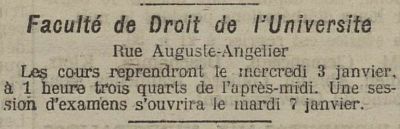
The University of Lille and its law school during the Great War
Summer 1914: it is war Before the start of the academic year in November, only the summer French courses for international students were disrupted by the outbreak of war in August. This summer school took place in two sessions, one in July and the other in August, in Boulogne-sur-Mer. In the summer of 1914, 216 students were enrolled. The courses covered literature, French civilization, phonetics, grammar, style, reading, conversation and translation. Of the 143 students enrolled in the July session, 69 were English, 35 were German, 14 were Russian, 7 were Austrian, 5 were Hungarian, 4 were Swedish, 2 were Dutch, 2 were Canadian, 2 were French, 1 was American, 1 was Colombian and 1 was Finnish. The secretary of the society of patronage ofpour lire la suite…
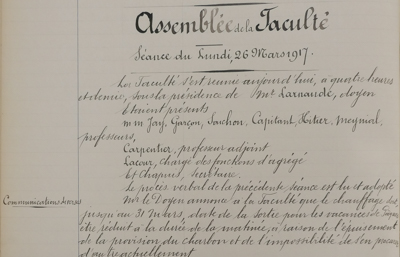
Daily life in the Paris Faculty of Law during the war
“In the life of a faculty, as in that of a family, events repeat themselves, almost always the same, which are the most numerous and the most necessary. Sometimes new events occur, bringing about a modification, small or large, in their organization and operation. Those are necessary as well, but they must not be too frequent, lest they bring about too great an instability into an existence whose continuity and regularity are, in a way, the fundamental principle. The life of bodies, as that of families thus includes happy and unhappy events alike. Would it really be life otherwise?”; these remarks were expressed by Dean Ferdinand Larnaude in 1921, in the annual report on higher education institutions of the Paris Academy (law school). Larnaude, whopour lire la suite…