
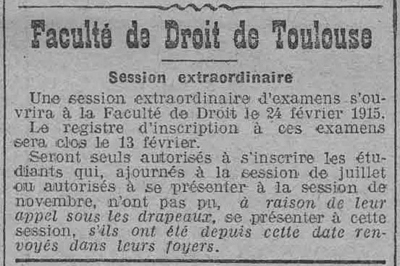
On June 9, 1929, on the occasion of the commemoration of the 700th anniversary of the creation of the University of Toulouse, law historian Joseph Declareuil (1863-1938) recounted the history of the institution. He mentioned “twenty generations of masters and students who successively appeared, thought, acted, fought to acquire knowledge, then vanished under the veil of the fleeting time” and proposed to “draw some lessons from this great past”. Unwinding the thread of the long history of the Studium Tolosanum, he focused little on the law school during the late 19th and early 20th centuries. He quickly alludes to new chairs and courses, the creation of institutes, relations with practical law and notarial schools, and the reformation of the University of Toulouse in 1906. He,pour lire la suite…
Author: Des facultés sur le front du droit
Institutions in the face of history
15 June 20239 November 2023 Des facultés sur le front du droitInstitutions in the face of History The Toulouse Faculty of Law in the war On June 9, 1929, on the occasion of the commemoration of the 700th anniversary of the creation of the University of Toulouse, law historian Joseph Declareuil (1863-1938) recounted the history of the institution. He mentioned “twenty generations of masters and students who successively appeared, thought, acted, fought to acquire knowledge, then vanished under the veil of the fleeting time” and proposed to “draw some lessons from this great past”. Unwinding the thread of the long history of the Studium Tolosanum, he focused little on the law school during the late 19th and early 20th centuries. He quickly alludes to newpour lire la suite…
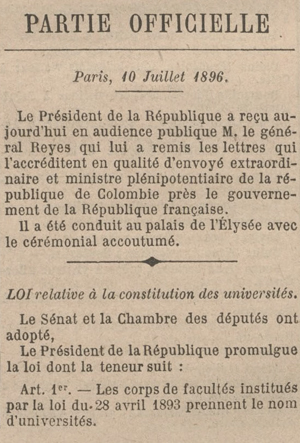
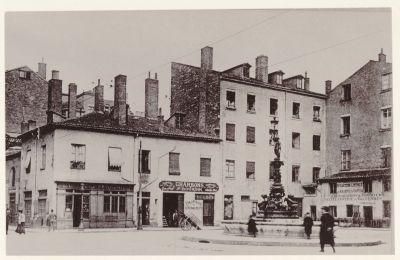
The Catholic Faculty of Law in Lyon on the Eve of War
In 1913, during the solemn opening ceremony in November, the dean, Charles Jacquier, presented his report and praised the successes of the Catholic Faculty of Law in Lyon, particularly the consistency of its student numbers. He does not yet know that six years will pass before the next solemn opening ceremony, with the Great War sweeping across France a few months later and disrupting the lives of teachers and students alike. On the eve of the war, the organisation has hardly changed since its beginnings. It should be noted that the Catholic Faculty of Law was inaugurated in November 1875, two years later appeared the Catholic faculties of humanities and sciences, thus allowing the use of the term Catholic University to describe all the faculties.pour lire la suite…
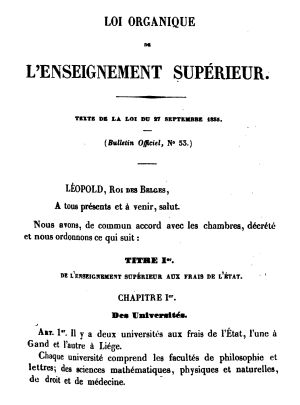
The Belgian academic landscape before the First World War
The Belgian academic landscape as it had developed from the first law on higher education of September 27, 1835 is the result of a historic connection as well as a parliamentary consensus on freedom of education, geographical decentralization and structural centralization. The history of higher education in Belgium in the contemporary era began at the turn of the 19th century, when the “Belgian” space annexed to the Republic, a bundle departments, saw in 1797 the closure of the former University of Leuven. It was a casualty of the abolition of universities by the decision of the National Convention of September 15th, 1793. After a period of apparent vacancy, higher education in the “combined” departments was subject to Napoleonic reforms. The Act of Ventôse 22, XIIpour lire la suite…
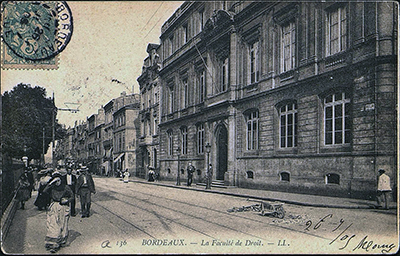
Dissolved, temporary, consecrated: the difficult resurgence of the Bordeaux Faculty of Law
Despite being a pioneer of higher education with its auditorium and the lectures of Ausonius (? 310-394) in the 4th century of our era, Bordeaux had to wait a long time before the opening of its first official university. A rich city and major trading port, it only became a place of legal education during the 15th century with the creation of the Universitas Burdiagalensis. Its structure remained substantially the same for nearly 350 years before being swept away by revolutionary impulses. The city produced many renowned jurists such as Nicolas Boerius (1469-1539), Bernard Automne (1574?-1666), Étienne Cleirac (1583-1657), Abraham Lapeyrère (1598?-1690?), or even famous member of parliament Charles Louis de Secondat, baron of La Brède and Montesquieu (1689-1755). In Bordeaux as in many otherpour lire la suite…
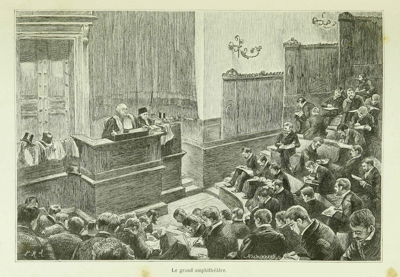
Toulouse and Paris: the ties of competing law schools
Paris and Toulouse are the two most important law schools in France. Throughout the 19th century, they dominated the French academic landscape, notably by their attractiveness, their enrollment numbers and the degrees they awarded. They and a dozen other legal faculties on the territory created by Napoleon from as early as 1804 shared the same professionalization objective: they organized examinations and delivered the titles necessary for the practice of legal and judicial professions (magistrates, lawyers, teachers, etc.) to children of the most privileged classes. Everywhere, education was focused on civil law, Roman law and procedural law. Little to no provision was made for other branches of law (administrative law, commercial law or legal history). The contemporaries, among whom some famous writers (Balzac, Zola and others),pour lire la suite…
Institutions and their history
15 June 20239 November 2023 Des facultés sur le front du droitInstitutions and their history Toulouse and Paris : the ties of competing law schools Paris and Toulouse are the two most important law schools in France. Throughout the 19th century, they dominated the French academic landscape, notably by their attractiveness, their enrollment numbers and the degrees they awarded. They and a dozen other legal faculties on the territory created by Napoleon from as early as 1804 shared the same professionalization objective : they organized examinations and delivered the titles necessary for the practice of legal and judicial professions (magistrates, lawyers, teachers, etc.) to children of the most privileged classes. Everywhere, education was focused on civil law, Roman law and procedural law. Little to no provision waspour lire la suite…
Institutions in the Great War
In France and abroad, all the components of higher education were caught up in the war. Old or recent, French or foreign, their daily lives were permanently disrupted. The human and practical impact of mobilization being felt in various ways, depending in particular on whether they were in a non-occupied or occupied area (Lille, Belgium), how did law schools (and their libraries, which with the Third Republic in France became the support of the scientific mission that the faculties must also fulfill) adapt to the new context sparked by the Great War? Where and how was law taught? How were the faculties reorganized? How did they function on a daily basis? What were the forms of their involvement in the war effort? Institutions and theirpour lire la suite…