

The Catholic law faculty had just finished its degree exams when war broke out, but despite the events, it reopened its doors in November. However, due to the conscription of almost all of their students, the theology faculty and university seminary were unable to resume classes. Classes resumed on November 4 for first- to third-year law students, but without the traditional formal opening ceremony, which was suspended for the duration of the war. In 1914, a mass celebrated by the cardinal chancellor on November 19 and attended by teachers and students replaced the ceremony. Not many professors were called up during the war (only twelve from all the Catholic faculties in Lyon). To our knowledge, only Emmanuel Gounot, a young lecturer (aged 29 at thepour lire la suite…
Author: Des facultés sur le front du droit
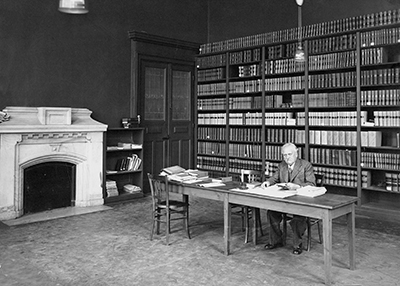
The Lyon Faculty of Law after the war: promoting peace through law
Even before the signing of the armistice with Germany, the University of Lyon had entered fully into this movement characterized by the efforts of civil society, in order to convert military relations between allied nations into cultural exchanges that were hoped deep and fruitful. The Alliance thus sought to renew itself, while deepening itself, since one would strive to access facets hitherto totally unknown or little known to the culture of yesterday’s military ally. In short, it was hoped that the temporary fraternity of arms would be converted into a solid friendship, which would, however, be lasting only if each made the effort to know the other better. It was American academics, grouped within the American University Union (AUU), who, even before the end of thepour lire la suite…
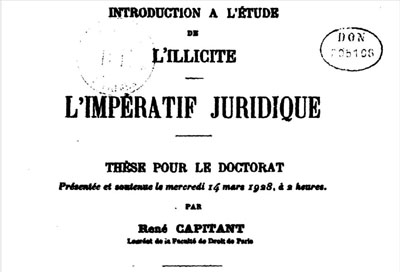
From the “legal war” to the “Roaring twenties” of legal science
Law was at the heart of the struggle between the Axis and Entente powers. French jurists used all their rhetorical weapons to spread the values of “Latin civilization” in the face of “Teutonic barbarism”. The propaganda of the war of law against force revived hatred and the desire for revenge against an enemy hated as much as it was admired since its victory in 1870, which is attributed to the supposed superiority of German universities. Argument of mobilization of the fighting masses, the legal war was transformed into an ideological opposition between two models with hegemonic pretensions, one valuing “the French genius”, the other the German “kultur“. In this confrontation of paroxysmal violence, jurists were on all fronts. Engaged in the trenches or serving at thepour lire la suite…
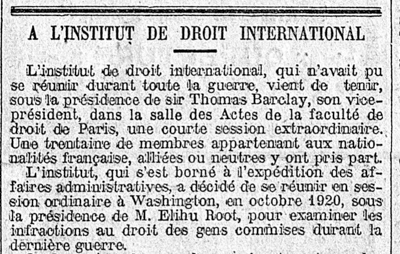
French Law faculties on the post-war media scene: a vengeful and hopeful reconstruction
A test for French society as a whole, the Great War was also a test for academic environments, law schools especially. These “diverse little societies”, as Immanuel Kant called them, which would be a part of the “scientific state” that is the University, were devastated by a conflict that mobilized the whole of society in the war effort. Law schools, according to a well-established tradition, had so far remained rather closed on themselves. Enjoying the position of “professional faculties”, in the same way as the faculties of medicine, they did not cease to attract in their amphitheaters, promotions of students whose important numbers guaranteed the finances, as well as the growth of the teaching staff. In addition, this influx made it difficult to even usepour lire la suite…
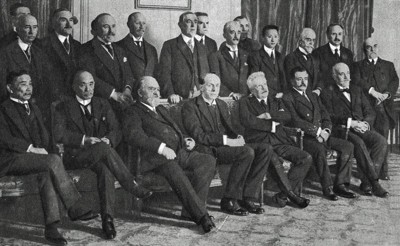
Participation of French jurists in the Peace Conference of 1919
At the end of the conflict, the victors of the First World War had wished to give a new legal colour to the Europe that would appear on the debris of the fallen empires. Clemenceau had thus spoken of the creation of a “Europe of Law” which should be the ultimate objective of the Allies when they went to negotiate peace. In this context, the Allies had to rely on legal experts, in particular international law experts, whose technical advice had been regularly sought for the purpose of providing expertise. “Jurists” here shall refer to those who through their training knew the Law, and thus practiced or applied it. What mark did the French lawyers leave on the negotiations and the peace treaties? Did theypour lire la suite…
Reconstruction
15 June 20239 November 2023 Des facultés sur le front du droitReconstruction The Lyon Faculty of Law after the war : promoting peace through law Even before the signing of the armistice with Germany, the University of Lyon had entered fully into this movement characterized by the efforts of civil society, in order to convert military relations between allied nations into cultural exchanges that were hoped deep and fruitful. The Alliance thus sought to renew itself, while deepening itself, since one would strive to access facets hitherto totally unknown or little known to the culture of yesterday’s military ally. In short, it was hoped that the temporary fraternity of arms would be converted into a solid friendship, which would, however, be lasting only if each madepour lire la suite…

Students from the Catholic Faculty of Law in Lyon killed during the Great War
A significant number of students from the Catholic Faculty of Law were mobilized, and many of them died during the Great War. At the opening ceremony in 1919, Dean Charles Jacquier announced in his report that 55 students or former students had been killed during the war. This is probably a slightly low estimate, according to data published in the Bulletin des facultés catholiques de Lyon. This newsletter was first published in 1880 and was initially edited by Abbé G. Wedrychowsky, director of the subscription fund. The Bulletin served to liaise between subscribers to the Catholic University, informing them of what was happening in the faculties and the progress of the subscription fund. A key source of information on the life of the Catholic faculties ofpour lire la suite…
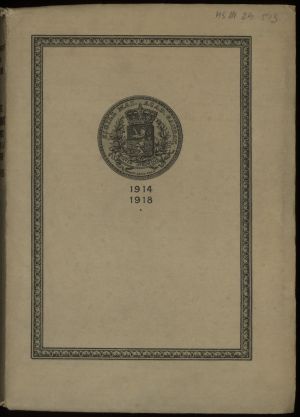
Traces of memorial practices in remembrance of law faculty academics who died during the Great War: Brussels, Leuven, Liège
Those who gave their lives for an ideal of justice, those who died for the law, have left the survivors a legacy that must not be made up solely of contempt and hatred. Paul Héger, Academic opening session of the Free University of Brussels, January 21, 1919. Confronted with the magnitude and violence of the mass death caused by the Great War, the deep trauma that ensued drove society towards an irrepressible need to mourn and remember those lost. Mourning is an intrinsic part of the war experience. It is present from the outset of combat and continuing after the war, and is a bond that unites combatants and non-combatants in the loss of a son, husband, brother, or “comrade”. Its expression is multifaceted: it tends topour lire la suite…
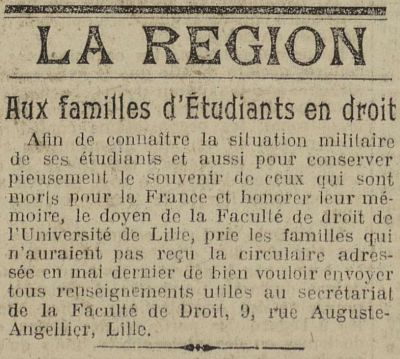
War and student death at the Lille Faculty of Law (1914-1918)
The commemorative plaque, now set in front of the entrance, in the largest hall of the Lille Faculty of Law, does not attract attention. And yet it is up for everyone to see, both from the ground and from the hallways, in particular the one leading to the hall of acts, where the audience gathers during the defense of theses. Although the commemoration of the centenary of the First World War sparked a renewed interest in this monument, it has absolutely nothing to do with the emotion that gripped all those who, in the aftermath of the conflict, lifted their eyes to the impressive list of names engraved in marble. Mass death At the start of the 1913-1914 school year, there were 351 students. At the firstpour lire la suite…
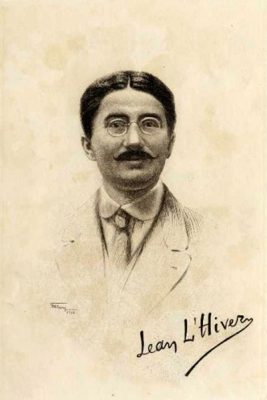
Stories of Bordeaux students who “died for France”
The outbreak of war in the summer of 1914 led all European states to solicit the greatest sacrifice from their able-bodied male population. Thus France solicited most of its twenty years old citizens, nineteen even, till the past forty, to join the ranks of the active army. Even if the students appeared as a minority, their departure to the front left a mark. By themselves, they embodied youth, as students were the only social group composed almost exclusively of young people. From then on, the faculties concentrated what could be called “the youth of France”, scrutinized in particular by journalists. In the provinces, student populations were much less important than in Paris. Nevertheless, they continued to grow, as in Bordeaux, where the number of studentspour lire la suite…