
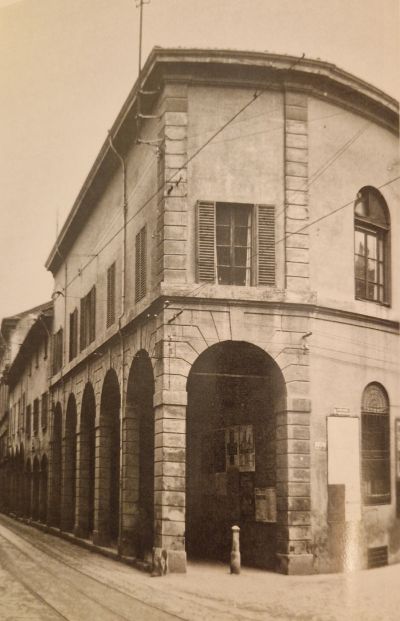
On the eve of the outbreak of the Great War, the organisation of the Faculty of law of Bologna was governed, like the sixteen other universities of the Kingdom of Italy, by the unique text on the laws on higher education, approved by the royal decree of the 9th of August 1910, no. 795, which gathered and coordinated the previous legislation, as well as the corresponding general regulation of universities, approved by the Royal Decree no. 795 of 9 August 1910.
These texts provided the mandatory teaching of eighteen fundamental subjects in order to obtain the degree of laurea. The study plan developed by the faculty of law of the Alma Mater (nickname of the University of Bologna as the oldest university in Europe) divided them over four years and also provided that some courses extend over two years (history of Italian law, Roman law, civil law, criminal law and criminal procedure). Furthermore, it separated administrative law and administrative science into two distinct courses, entrusted to two different incumbents: the first to Domenico Mantovani Orsetti (1831-1919), and the second to Luigi Rava (1860-1938), who had served as Minister of Public Education from 1906 to 1909. All courses were taught by tenured professors of the faculty, with the sole exception of forensic medecine, which was entrusted to Paolo Pellacani (1854-1920), a professor in the Faculty of Medicine and surgery (since the work of Cesare Lombroso (1835-1909) in criminology, the latter subject is an Italian specialty, that had not yet found an equivalent in France). The Casati Law of 1859, amended over time, regulates the recruitment of professors, either by competitive exam or, to a lesser extent, by appointment by the king. The final exam consisted of a defense of an essay written by the candidate on a subject he had chosen himself from among the subjects of his curriculum, as well as a discussion of several theses – at least three in number, also chosen by the student – from other subjects.
The University – and thus also the Faculty of Law – had its headquarters in Palazzo Poggi, via Zamboni, where it was transferred during the Napoleonic era. In this same building were installed, from 1911, the Legal Seminar, created to promote the deepening of the courses already given at the faculty, as well as a specific legal library, which was enriched by a policy of judicious acquisitions and the generosity of those who made important donations, thus contributing to making the Bologna library one of the richest legal libraries on the peninsula. From the same year, as a result of the royal decree no. 796, the dean of the faculty was appointed by the king from among three candidates proposed by the faculty council.
During the academic year 1914-1915, marked by the outbreak of the First World War, the law faculty was headed by the legal historian Francesco Brandileone (1858-1929). Dean from the end of 1911 until 1921, he then left Bologna for the Sapienza University of Rome. In that year, he held the chair of ecclesiastical law, to which he had been called in 1906: this fact is significant, because it marked the autonomy of this discipline with respect to the history of law.
Alongside Brandileone, the teaching staff included personalities of great national and international prestige, starting with the three romanists: Giuseppe Brini (1856-1941), professor of Roman law; his student Emilio Costa (1866-1926), an eclectic personality, called to the chair of history of Roman law; and Silvio Perozzi (1857-1931), incumbent of the institutions of Roman law. Augusto Gaudenzi completed the ensemble of the legal history courses. Extraordinary professor of the history of Italian law since 1886, he was the leader of the researchers who gave, in Bologna, a particular orientation to research and teaching in this field.
The course of philosophy of law was taught by Giorgio del Vecchio (1878-1970), who contributed to questioning positivist philosophy in Italy through several works of jusnaturalist tendency published precisely during his Bolognese decade, from 1910 to 1920. A marked historical sensitivity characterized, on the other hand, the work of the internationalist Scipione Gemma, who associated the study of law with that of history, apprehended through treaties, that is to say, the written acts of international practice.
In field of criminal law, criminal procedure and criminal law, still combined in a single teaching, were entrusted to Alessandro Stoppato (1858-1931), representative of what was called “civil criminal science”, which combined the “criminal reason” typical to the classical school, closest to him, and the “civic commitment” of the positive school. His contribution was not limited to his scientific and educational activities: Stoppato played a leading role in the drafting of the Code of Criminal Procedure, that entered into force in 1913.
The chairs of private law courses were no less eminent. The chair of commercial law was occupied by Leone Bolaffio (1848-1940), appointed to Bologna in 1898 following the departure of Cesare Vivante (1855-1944) for Rome. He maintained a close scholarly collaboration with the latter, which culminated in the joint direction of a commentary on the Commercial Code of 1882 which was very successful.
This presentation ends with the most well-known name, that of Giacomo Venezian (1861-1915), a major figure in the civilist doctrine of the late 19th century. Laureate of the open competition in 1899 thanks to his monograph Dell’usufrutto, dell’uso e dell’abitazione, he held the chair of civil law during the years preceding the world war, during which he heroically lost his life.
As for the student population, after the decline recorded at the end of the first decade of the century, probably due to the competition from the University of Ferrara, the Faculty of Law saw its enrolment rebound. During the academic year 1914-1915, enrolment had reached 364, thus reaching again the levels of the early 20th century.
Alessia Legnani Annichini, professor of law history (Alma Mater Studiorum, Bologna University)
Bibliography
Cavina Marco, Legnani Annichini Alessia, Docta suas secum dixit Bononia leges: storia della Facoltà di giurisprudenza di Bologna (XIX-XX secolo), Bologne, Società editrice il Mulino, 2024.
Legnani Annichini Alessia, « Laboratorio scientifico, biblioteca, luogo di studio. Dal Seminario Giuridico (1911) al Dipartimento di Scienze Giuridiche (2000) », dans Archivio Giuridico Filippo Serafini, vol. 237, no 1, 2017, p. 13‑104.
Legnani Annichini Alessia, Sarti Nicoletta, Maestri sotto concorso. Le prime tornate del reclutamento nelle Facoltà giuridiche dei grandi Atenei del Regno d’Italia (1860-1896), Mucchi, 2025.
« Décret royal du 9 août 1910, no 796 », dans Gazzetta Ufficiale, no 277, 29 novembre 1910, p. 6377‑6395.
« Décret royal du 9 août 1910, no 795 », dans Gazzetta Ufficiale, no 280, 2 décembre 1910, p. 6453‑6474.
Annuario della Regia Università di Bologna, 1914-15, Bologne, Grafici Riuniti, 1915.